


























































How to build a stablecoin neobank
An operator's playbook for the regulated money-movement layer: the market, the models, the corridors, and the stack.
A 26-page field guide for founders, investors, payments teams and compliance leaders evaluating stablecoin-powered cross-border products.
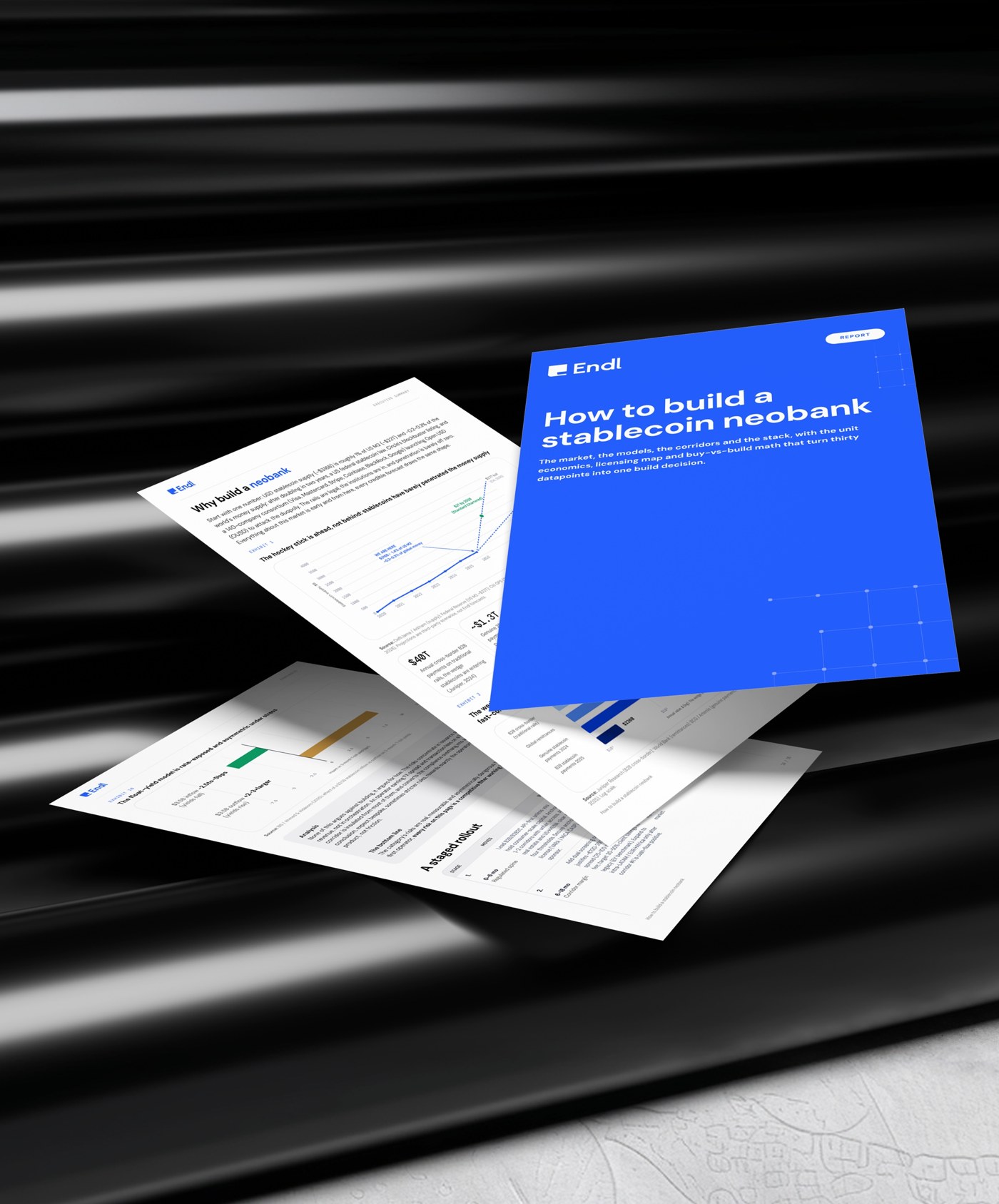
Cross-border money still runs on correspondent banking: slow, costly, opaque. Stablecoins settle the same value in minutes. The opportunity is not a token. It is the regulated money-movement layer built on top of one.
Endl research
Six decisions the report helps you make
- 01
Choose the model
Five models scored on CAC, gross margin, time to revenue and defensibility: B2C, B2B direct, B2B2C, whitelabel and API-first. Each gets a verdict for a new entrant.
- 02
Pick the corridor
Four worth-entering thresholds, a corridor map of seven candidates, and three worked corridor profiles: where legacy rails are expensive, slow, or structurally broken.
- 03
Map the licensing path
US, EU, UAE, Singapore and UK compared on regime, timeline and indicative cost, plus the hub-and-spoke pattern serious operators use to cover the rest.
- 04
Assemble the stack
Collection, payout, custody, KYC and KYB, Travel Rule and screening, mapped layer by layer with named vendors and indicative pricing.
- 05
Model the economics
Five revenue lines, the full cost stack across a transfer's five hops, and the worked $10,000 example down to the $29.95 contribution.
- 06
Decide buy vs build
Layer-by-layer verdicts on what to rent and what to own: renting the stack takes about two weeks; building it takes 12 to 24 months and $3 to 11M upfront.
See the full contents: 16 sections in three parts
The argument in four moves
Why a regulated stablecoin neobank is buildable now and was not two years ago.
A stablecoin neobank is a regulated payments company
The layer model, and where each layer earns.
Market size and structure
How large the market is, and how concentrated.
What stablecoins are actually used for
Trading dominates today; payments is the open lane.
Issuer economics and the timing
Why the unit economics are extraordinary, and why the regulatory window is open now.
Choosing a business model
Issuer, orchestrator, neobank, or infrastructure, scored on license, capital, margin, moat, and time.
The stack and revenue
The four layers you own and the five lines you earn on.
Picking a corridor
Where friction is high, flow is real, and competition is thin.
Adoption and the competitive field
Where the category is adopting fastest, and who already plays there.
Licensing by jurisdiction
UAE, Singapore, EU, US, UK, and which anchors the thesis.
Collection and payout
How money gets in and out, corridor by corridor.
Wallets and the compliance spine
Custody, KYC tiers, Travel Rule, and screening.
Anatomy and cost of a transfer
The five hops, and where the ~45 bps goes.
Buy versus build
What to rent to launch in months, and what to build to stay.
The five risks that matter
Regulatory, reserve, liquidity, float, and counterparty, each with a mitigation.
A staged path to launch
Secure the perimeter, win one corridor, then widen, with an exit test at each stage.
The numbers that frame the build decision
A free preview of the figures the report is built on.
The cap doubled in two years: ~$133B (2023) to ~$316B (2026), roughly 1% of US M2. Every credible forecast draws the same shape from here.
The duopoly is under open attack: USDT + USDC still hold ~85%, but Open USD (140+ partners, yield shared with distributors) is contesting it. Float economics are migrating to whoever owns distribution.
Corridors clear the bar by wide margins: global remittances average 6.49% and bank wires reach up to 13.65%, versus 0.15 to 0.45% all-in on stablecoin rails.
Regulation turned tailwind: the GENIUS Act signed July 2025; MiCA live in the EU, lifting compliant EURC volume ~2,727% while walling out the unlicensed.
Public markets are pricing the category: Circle listed, Gemini and Bullish followed, BitGo filed, and Mastercard acquired BVNK (~$1.5B).
The stack is buyable: MoneyGram launched stablecoin remittance rapidly on rented rails. Buy the plumbing; own the corridor.
Selected exhibits
The report is figure-led. Every argument lands on a numbered chart or a named source.
Exhibit 01
The hockey stick is ahead, not behind
Supply is ~$316B, near 1.4% of US M2, with 2030 forecasts of $1.6 to $3.7 trillion.
Exhibit 02
Annual value, log scale
The wedge: a multi-trillion-dollar market from a small base
B2B cross-border is $40T; genuine stablecoin payments are ~$1.3T and compounding fast.
Exhibit 12
Where adoption is actually happening
Chainalysis 2025 index: India leads a third year, then the US, Pakistan, Vietnam, Brazil.
Who it's for
A build document for the people making the call, and the people underwriting it.
Founders and operators
A build plan, not a market brief. Decide model, corridor, and stack with figures.
Investors
The category map and the unit economics to underwrite the space.
Product and compliance leads
The licensing, corridor, and compliance detail to pressure-test a stablecoin move.
Why we wrote this
Endl builds the licensing, corridor, and compliance layer for a living, so the report is written from an operator's seat, not a vendor brochure. Every claim ties to a numbered exhibit or a named source. We wrote the guide we wanted when we started.